Cities & urban environments
Operational zones, roads, buildings, demand, infrastructure and incident scenarios.

DIGITAL TWINS · SIMULATION · DECISION SUPPORT
We model infrastructure, operations, assets and complex systems before major decisions are made.
01 / WHAT IS A DIGITAL TWIN?
A digital twin can bring together geospatial information, infrastructure layouts, operational data, sensors, workflows, incidents, AI and simulation.
GOHJI focuses on practical twins that support planning, resilience, operations, investment and deployment.
02 / WHY DIGITAL TWINS MATTER
03 / WHAT GOHJI BUILDS
Operational zones, roads, buildings, demand, infrastructure and incident scenarios.
Stations, fleet movement, response zones, incidents, training and multi agency interaction.
Logistics, movement, workflows, autonomous transport, critical spaces and system pressure.
Asset layouts, movement, access, occupancy, safety and future upgrades.
Networks, assets, maintenance, vulnerability points and operational dependencies.
Test how drones, quadrupeds and mobile robots perform before procurement or rollout.
Analyse movement, capacity, bottlenecks, workforce interaction and automation.
04 / WHAT A TWIN CAN INCLUDE
Not every project needs a fully live, sensor connected system on day one. Often the best starting point is a strategic or simulation twin.
05 / DIGITAL TWIN ARCHITECTURE
Sites · fleet · assets · people
Geospatial · sensors · history · workflows
Structure · relationships · constraints
Scenarios · incidents · alternatives
Comparison · planning · evidence
Risk · resources · procurement · ROI
05 / FROM MODEL TO DECISION SUPPORT
A twin becomes valuable when it answers real questions about stations, fleets, hospital logistics, facility constraints, severe weather, robotics and infrastructure.
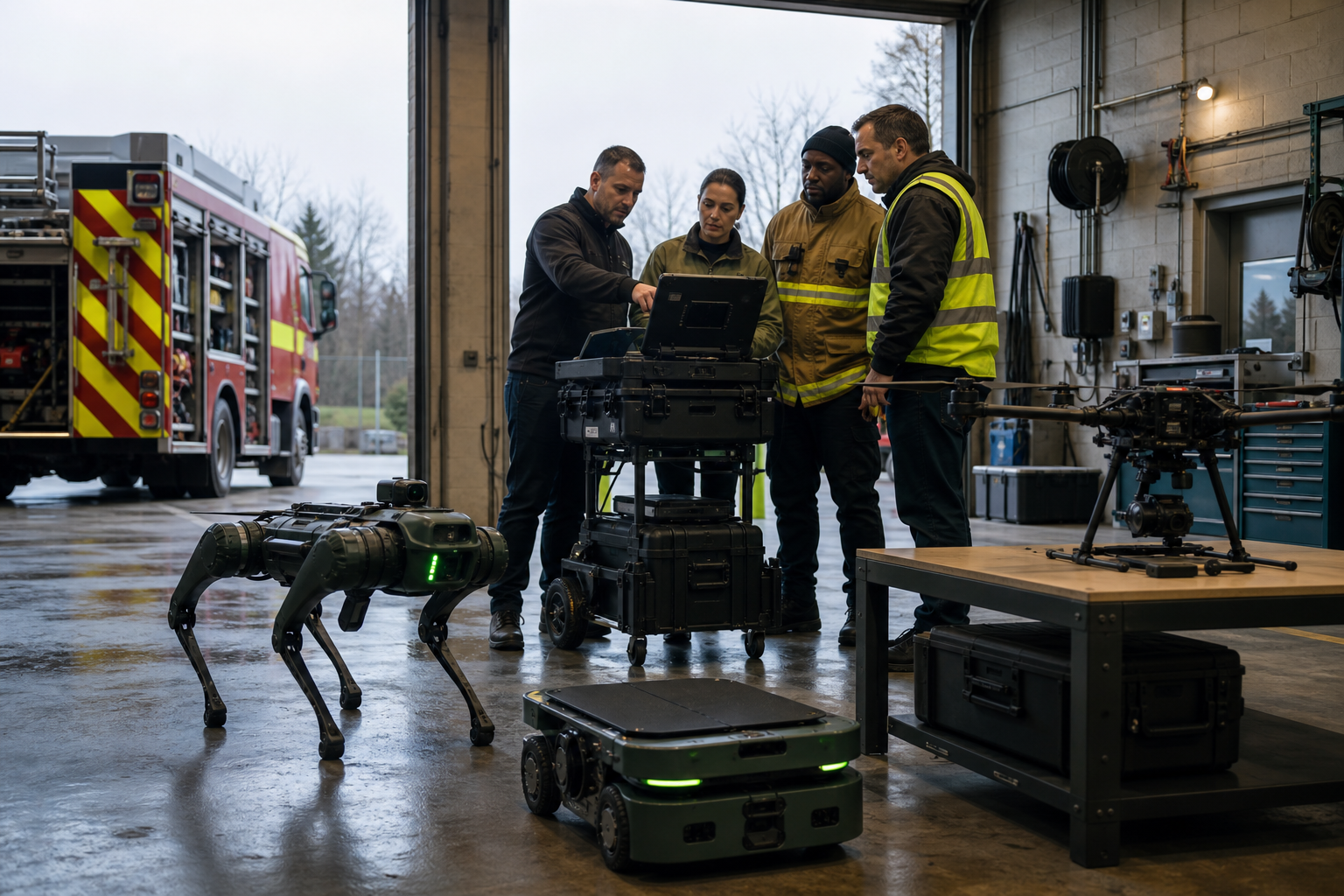
06 / ROBOTICS, AUTONOMY & TWINS
Evaluate movement constraints, safety, infrastructure, charging, communications, workflow fit, mission suitability, operational value and scale potential.
ROBOTICS & PROCUREMENT →07 / FINANCIAL & STRATEGIC VALUE
Test assumptions before major infrastructure, systems or procurement investment.
Explore scenarios without exposing staff, assets or services to disruption.
Give leadership clearer evidence, comparisons and measurable reasoning.
Understand bottlenecks, underused assets, route inefficiencies and deployment patterns.
Design trials around real operational conditions, not isolated demonstrations.
Connect cost, utilisation, time, performance and deployment outcomes.
08 / EXECUTIVE & PROCUREMENT VALUE
The value is not the model itself. The value is the ability to make better operational and investment decisions.
08 / HOW GOHJI WORKS
09 / TYPES OF ENGAGEMENT
10 / FAQ
No. Many high-value twins begin as structured digital models and simulation environments.
No. Scale and complexity should follow the operational requirement.
Yes. It can clarify requirements, test feasibility, compare options and strengthen the financial case.
Very much so. They can assess readiness, infrastructure needs and suitability before rollout.
Yes. An engagement can begin with a focused assessment or strategic twin.
LOOKING AT A SITE, SYSTEM OR TECHNOLOGY CHALLENGE?
GOHJI can define the environment, test the options and build the path forward.
REQUEST A DIGITAL TWIN CONSULTATION ↗DISCUSS A PILOT OR ASSESSMENT